Tag: media

  • oh, the British YouTubers

    the British are coming!
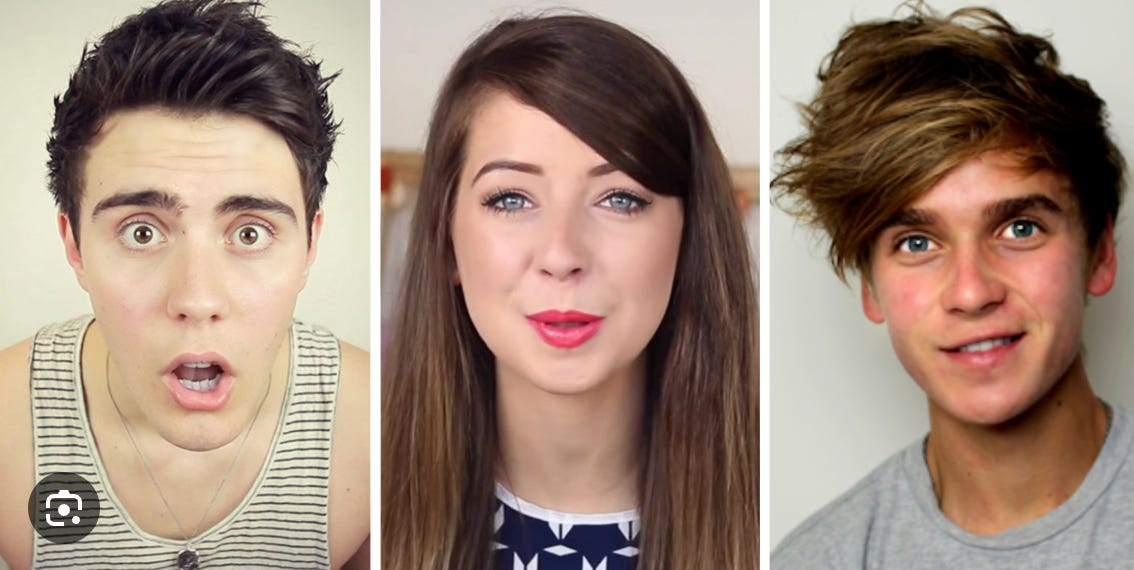

    Left to right: Pointless Bog, Zoella, ThatcherJoe Photo by The Tab.UK

    Los Angeles was not the only city where YouTubers started to pop up, as concurrently across the Atlantic Ocean, the UK started to see a small batch of their own YouTubers in the early 2010s. Thus, the arrival of the British YouTubers.

    Early British YouTubers were Zoella (Zoe Sugg), Jacksgap (Jack & Finn Harries), sprinkleofglitter (Louise Pentland), danisnotonfire (Daniel Howell), theamazingphil (Phil Lester), Caspar (Caspar Lee, South-African), PointlessBlog (Alfie Deyes), thatcherjoe (Joe Sugg), Marcus Butler, charlieissocoollike (Charlie McDonnell), Jim Chapman & Tanya Burr. My introduction to British YouTubers actually started when I began to listen to One Direction, which was the summer before middle school. Conveniently, that same the summer Olympics were being hosted in London. I would watch YouTube compilation videos of the boys during their X-Factor days, and their video dairies one after another. I was ultimately charmed and enthralled by this new promising boyband. I don’t think I speak alone here that those early compilation videos on YouTube of One Direction throughout bootcamp in X-Factor was my starting point in being a dedicated Directioner, as I and other fan accounts on Twitter (yes, Twitter) would bond over this pivotal point in our Directioner journey.
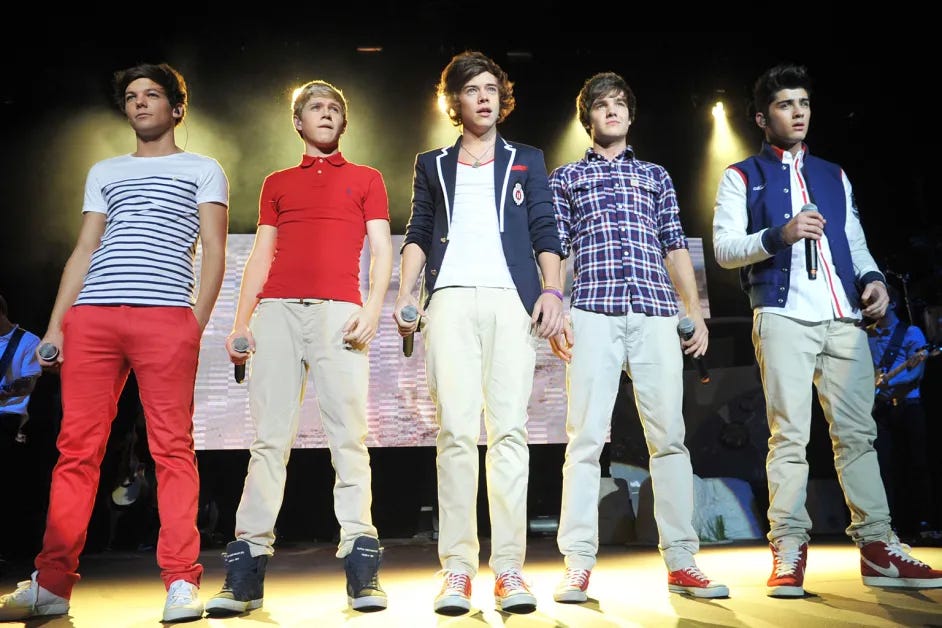
    Photo by Rex via Shutterstock

    Honestly speaking, watching British YouTubers back in 2012 was a strategy to gather intel about British culture, in an attempt to feel connected to my favorite boyband. To me, it felt like the more information I gathered about the UK and all things related to 1D; I was to be certified in my expertise as a Directioner. At the time, every real Directioner ought to know that Louie liked carrots, Zayn was mysterious, Niall was silly, Liam was afraid of spoons, and Harry was charming. My middle school friends who were also Directioners followed the same strategy too. We’d chat over what new British slang we learned from various YouTube videos during lunch, like fancy and bullocks, and claim Nando’s as our favorite restaurant since Niall liked it so much. Some would often show up to class with their attempt of a messy hair bun, citing Zoella’s YouTube tutorial. I tried doing the messy hair bun on myself since everyone else was doing it, but my hair was too flat and stubborn, so I gave up on it. Since most of these hairstyles were being done by white woman with different hair texture, my friends and I still attempted to replicate it despite being a collective of Dominican, Puerto-Rican, Black, and Mexican girls.

    One Direction fever trickled its way down to British YouTubers, as male YouTubers Alfie Deyes, Marcus Butler, Joe Sugg, Caspar Lee, and Jim Chapman uploaded parody videos of themselves as a boyband. They called themselves ‘the YouTube Boy Band’. Of course, they weren’t an actual boyband, but when put together, the five of them could pass off as a boyband with their trendy outfits and dapper hairstyles. These parody videos would amass millions of views on YouTube.
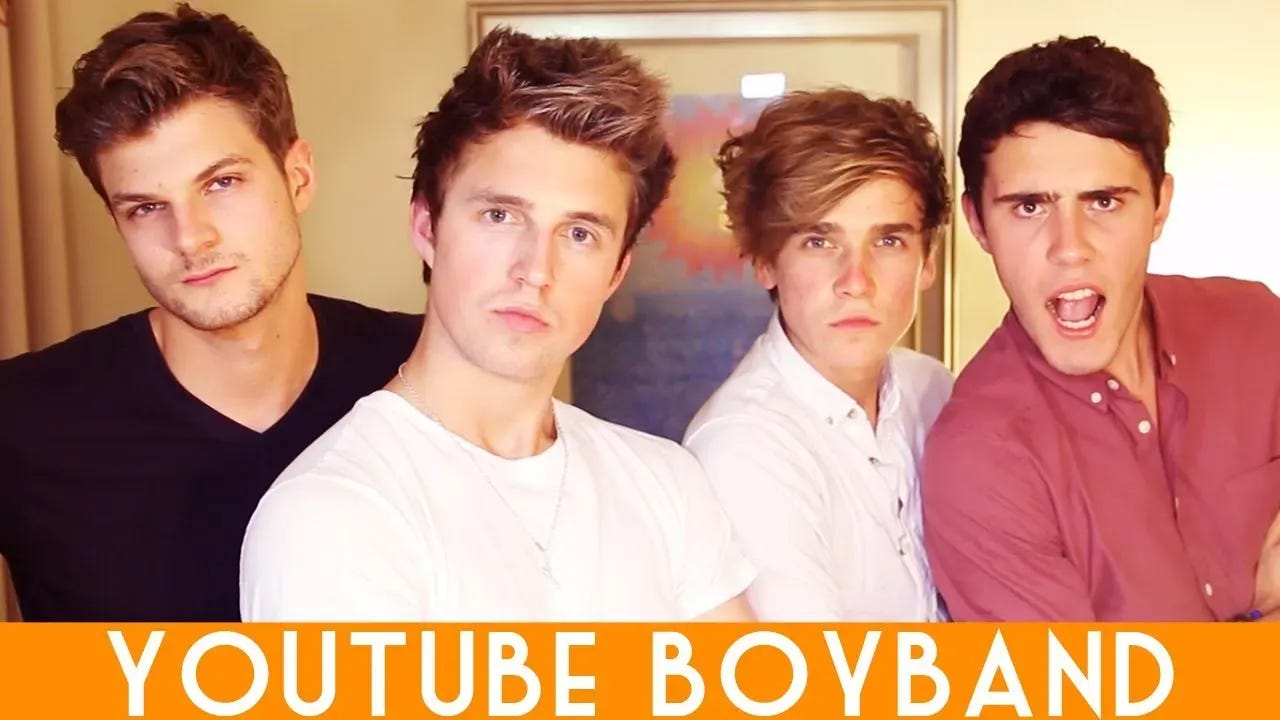
    Screenshot by me

    Teens also fangirled over Jacksgap, the twin brother duo, Jack and Finn Harries since they also were conventionally attractive British YouTubers. I didn’t really care that much about the British YouTuber boys, as I never really watched their videos extensively, but rather passively to be in the loop. I remember there being fan pages and wallpaper shared on Tumblr and Twitter dedicated solely to British YouTubers, thus commencing another fandom outside of One Direction.
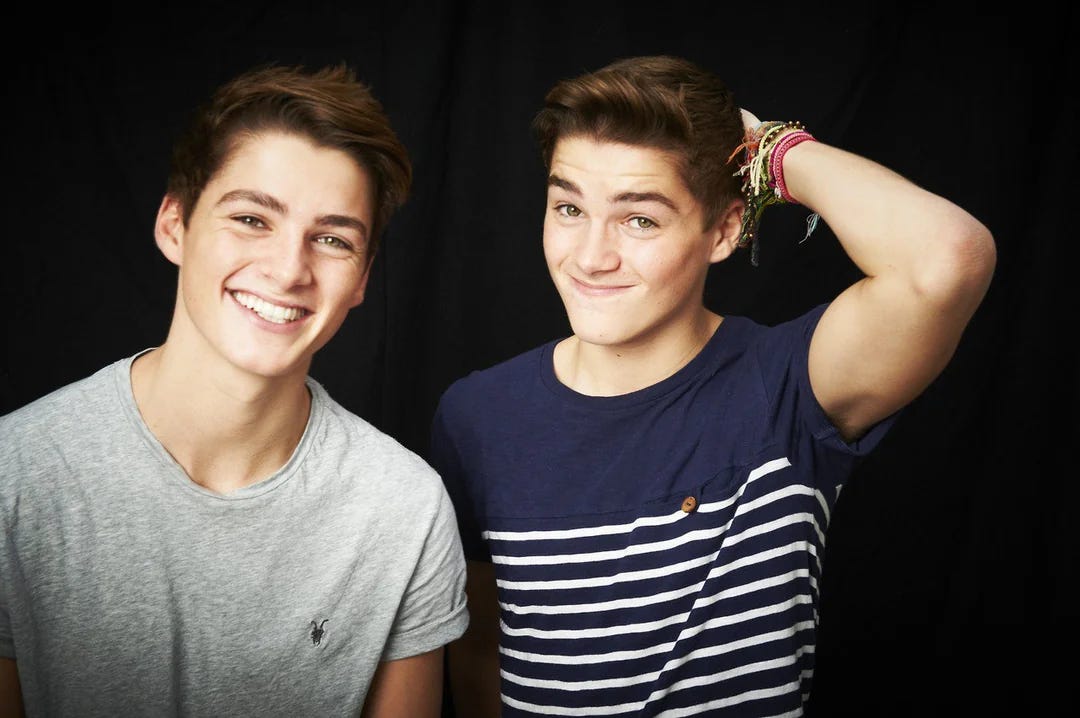
    Source unknown

    One thing that stood out to me about British YouTubers was the manner in which British YouTuber presented themselves on camera and how it was discussed online by their subscribers and other viewers. Early British YouTubers were deemed by YouTube viewers as clean-cut and ‘proper’ compared to their American YouTuber counterparts who were blunt and not as filtered.

    The easiest example that comes to mind is OG YouTuber Tyler Oakley. I believe Tyler Oakley was one of the first American YouTubers to collab with British YouTubers like Louise Pentland and Daniel Howell in his early videos. Tyler Oakley was an openly gay YouTuber known for being unapologetically himself and discussing pop culture. His collabs with British YouTubers were the most memorable videos to me from his channel. His flirtatious mannerisms and giggly personality that usually made people blush in his regular videos, was tenfold when it came to the Brits.

    As a media scholar and researcher now, this cultural trope and over characterization that British individuals are proper and traditionalists has always been evident in media like films and televisions, so it tickles my media brain that YouTube, a completely new & different form of media in the early 2010s, experienced a similar visualization and effect with British YouTubers despite being ordinary people, having no real public presence yet, were identified with familiar cultural tropes–often because it’s the easiest default understanding.
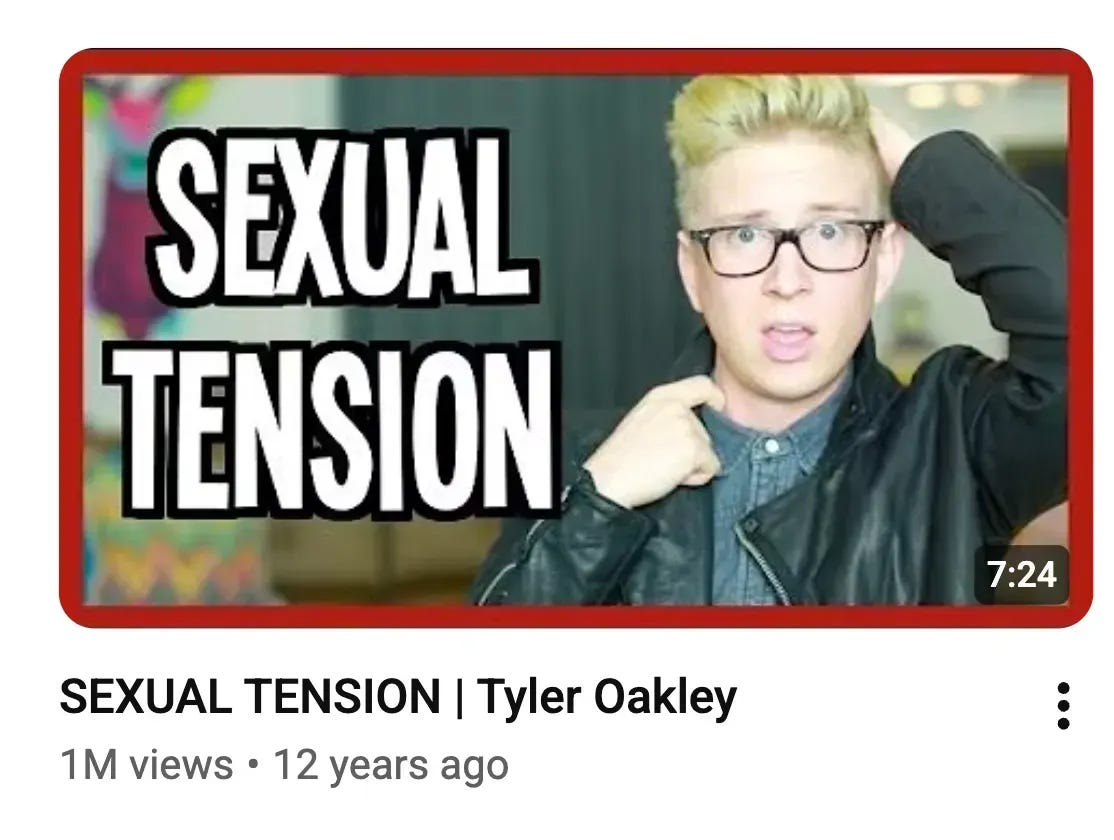
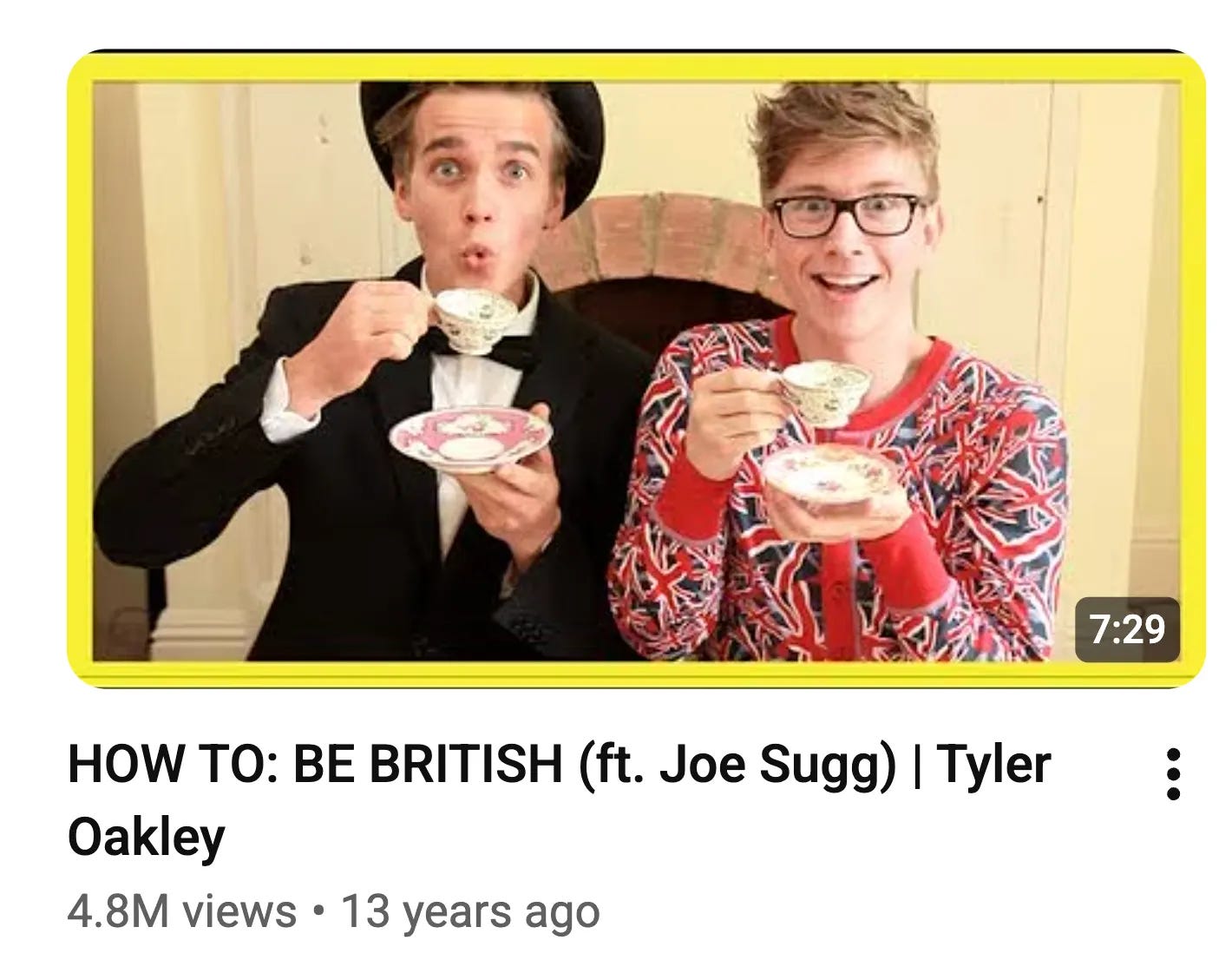
    Screenshot by me
    Screenshot by me

    Drawing back to my main discussion on the relationship between cities and content creation, I don’t find it surprising that early popular content creators came from two major western cities such as Los Angeles and London. In fact, it makes total sense that the introduction of a new form of media, that being YouTube, and creative class, content creators, (Richard Florida) would be driven forward by western forces such as the UK and the U.S. It’s not the first time that cities have been cited for leading new industries, new ideas, and the migration of new communities. I took a recent trip to the Museum of the City of New York, a museum I’ve never been to despite being a native New Yorker. I came across a quote by Richard C. Longworth, American writer and journalist, that stuck with me:

    This much we know for sure: cities are the future…In the 21st century, cities will be where the action is, where ideas and innovations spring up…For better or worse our future is urban.

    In the 21st century, where our understanding of the world has compartmentalized itself to the digital, but has also become heavily reliant on it since the introduction of Web 2.0, I think to myself, how can we not talk about the relationship that content creators & creation has on cities? That content creators themselves do not exist in a vacuum, and their online presence has real impact on the cities & communities they decide to engage or disengage with. Cities face a new wave of labor and capital, a digital presence that is enabled and built at its core through capital infrastructure, which is the new creative class–content creators. It is also worth mentioning that shortly after the COVID-19 lockdown, New York City followed after Los Angeles in seeing a rise in content creators migrating to the Big Apple–which I touched on in one of my earlier posts, you can read it here.

    On the case of British YouTubers, British YouTubers were increasingly getting popular around the same time American LA YouTubers were, or at least this is the way I viewed it as an American viewer. My research is not so much interested in the question of who came up first in YouTube amongst the Brits and the Americans, but rather the practice of doing YouTube like uploading videos and creating your own channel. Because how I view YouTube in this context is as a phenomenon that individuals were actively engaging in, a new frontier to embark on.

    Ultimately, I view the rise of British YouTubers complementary to One Direction’s worldwide popularity during 2011. I’m not saying that One Direction directly made British YouTubers popular or vice versa, but I’m just highlighting this relationship to indicate that these two cultural phenomena occurred simultaneously. The same way I view YouTube’s rise in popularity and creating content after the 2008 financial crash, and the same can be said with COVID-19 and the acceleration of content creators onto the working class. I know, it’s a leap from what I was previously talking about but stay with me.
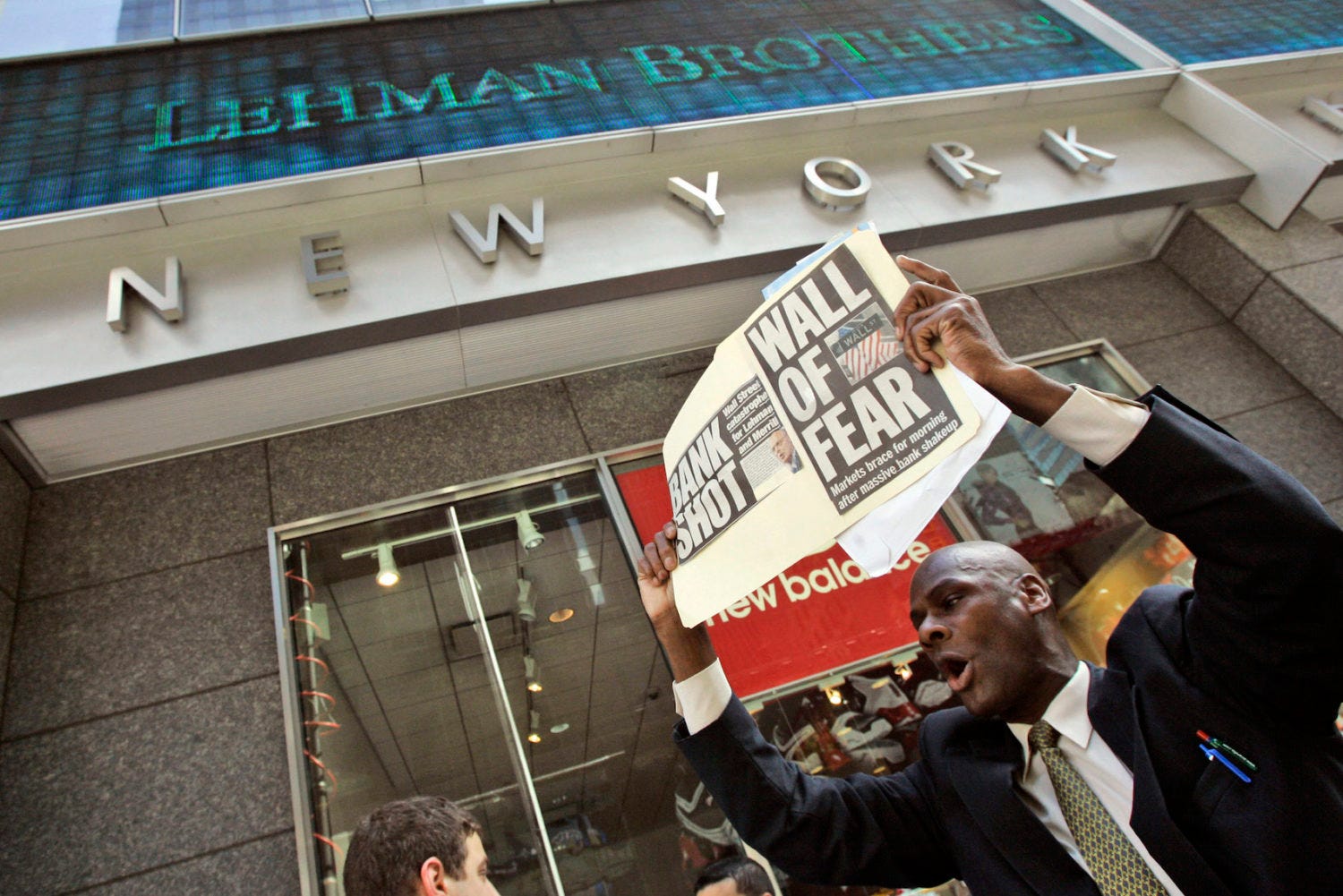
    The 2008 Financial Crisis, 10 Years Later: What Have We Learned? | WAMU
    Photo by Mary Altaffer/ AP

    The 2008 financial crash created capital catastrophe, thousands of people lost their jobs, the market crashed, and money was lost. The world seemed to be ending, or so, the capitalistic world was ending. Uncertainty was in the air, and institutions were at their barebones. But amidst all of this, a sliver of space is made that was once not there, a space where new forms of labor, creative expression, what have you, rises from the ashes. And from this space, new forms of ideas and existence take place and cements itself. If future careers, homes, and aspirations were at the mercy of the market crashing, why not try out the unconventional? Why not invest oneself into the possibility of luck. YouTube was that investment for young ambitious adults who did not want to rely on conventional forms of labor and economies. The same can be said when COVID-19 happened, with lockdown and jobs being forced to remote work, ordinary people began to create TikTok accounts, OnlyFans, and invest in the possibility of earning money from their social media accounts. I don’t mean to be dramatic here when I say this but capital drives on catastrophe.
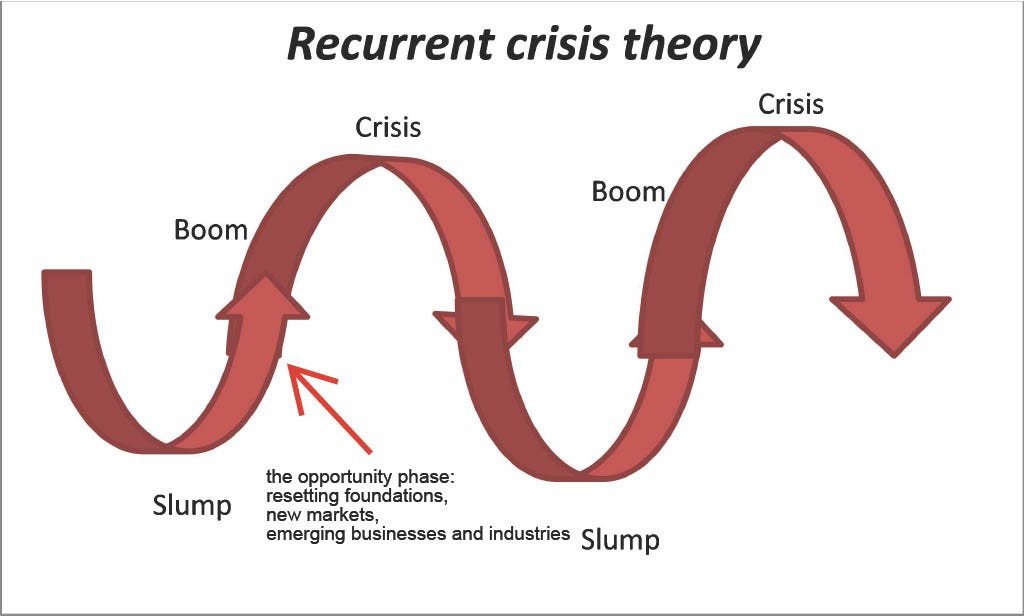
    Original diagram by Michael Roberts Blog, Edits made by me

  • The First Content Creators were YouTubers

    the gold rush of YouTubers


    Early YouTubers are the blueprint for what content creators and content creation is today. From the online personalities to the creative and ambition drive so many YouTubers have embarked and continue to do so both on and off the platform. I argue that the first content creators were YouTubers. YouTube as a platform then and now, serves as a blank canvas accompanied with the right video-sharing tools to launch and showcase ideas to a wider audience. It ultimately is a host holding, perhaps even collecting all of these ideas on its platform.

    The crux of content creation is presenting ideas, whether it be creative, educational, entertaining (honestly whatever it may be) and sharing it online for others to view. At least this is what makes the most sense to me, since Web 2.0, the current era we’re in, is interactive and allows users to communicate and engage in dialogue through social media–which early YouTubers achieved.

    Jeff J Mitchell via Getty Images

    My relationship to YouTube, as an avid viewer since the early 2010s is why researching content creators and content creation is so important to me as I feel a deep connection to it. I was in elementary school when I first learned about YouTube. My brother and I would spend time at the local public library afterschool and use the computers to surf the web. Aside from playing early online games like Poptropica and Habbo Hotel, towards the end of our web surfing journey, we’d somehow always end up on YouTube. I think one of the first videos I ever watched on YouTube was I Got a Crush On Obama. My brother and I would also spend most of our time watching music videos and lyric videos as that was pretty popular .

    Though my perception of YouTube changed drastically when one of my childhood friends informed me one summer that you can actually get paid for simply creating and uploading videos on YouTube. This was groundbreaking to me. Even though I was young, the concept of making money was as old as time to me since I came from a low-income household where the topic of money was always being brought up. My only knowledge about making money came from witnessing both my mother and father working conventional jobs, so the idea that you can earn money outside of working conventional and traditional blue-collar jobs was foreign to me. Though what was more foreign to me was making money on the internet, like was the money earned on the internet even real? where does this money even come from?

    That same summer my childhood friends, brother and I started to brainstorm what type of videos we could make to rack in some cash. As a bunch of kids with nothing to do and excitement on our side, the world was our oyster. We talked about making a short action and adventure videos at the park, where we’d all play different characters. Yet this never came to fruition as the summer came to an end. Mainly due to the lack of equipment, such as video-editing software, a decent camera, and tech skills that even with all of us combined was not decent enough compared to other early videos that was being uploaded at the time. We were just kids excited about a new tool on the internet. Despite my failed attempt to create and upload videos of my own in the early days of YouTube, I continued to go onto the platform and watched videos that strangers would upload onto their channels instead. I would also occasionally watched music videos from VEVO’s YouTube channel.

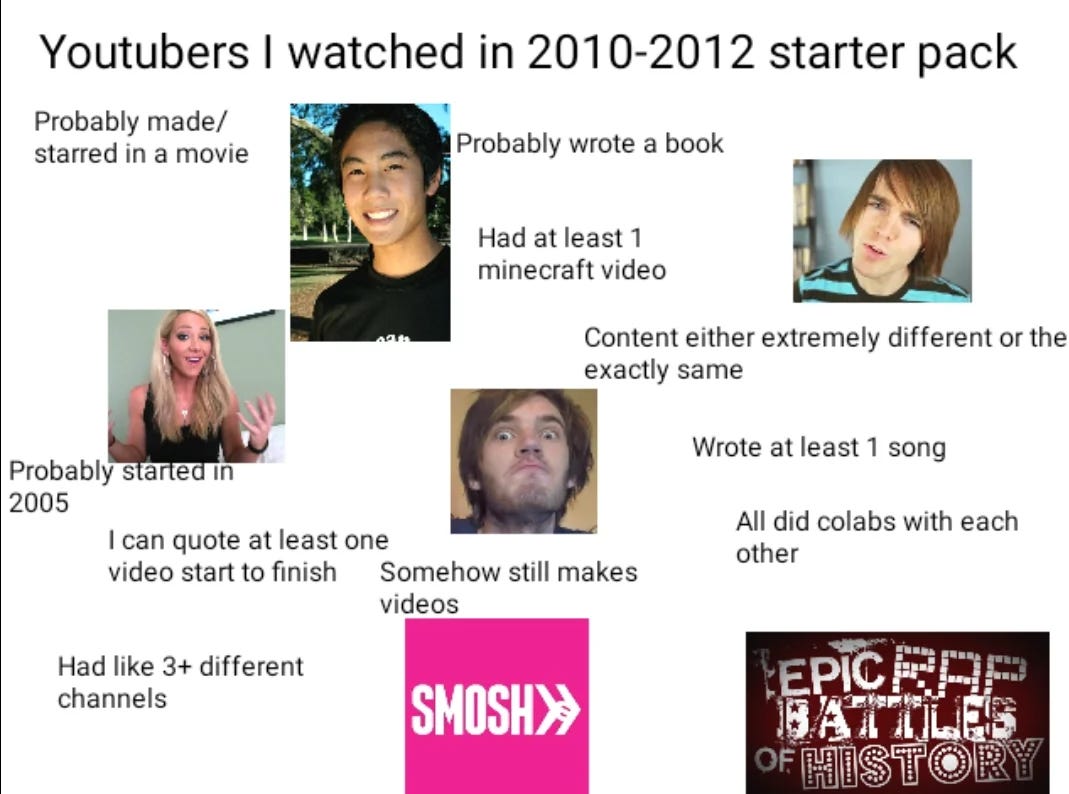
    By the time I had hit middle school in 2012, YouTube had changed and grown, as so many newcomers had joined the platform. Some early YouTubers I watched from this era of YouTube were Glozell, the now infamous Shane Dawson, Grace Helbig, SMOSH, Joey Graceffa, Strawberry17 and so much more. Every time a new video was uploaded by my favorite YouTuber I was tuned in, as going onto YouTube became my new form of entertainment. When it came to talking to other kids at school, the conversation at lunch was not about who was your favorite singer or actor, instead it was who was your favorite YouTuber? At this time I was also introduced to Tumblr and Twitter.

    Ultimately, as an impressionable angsty pre-teen I felt connected to my favorite YouTubers behind the screen as they uploaded videos about their opinions on the world, pop culture, and other various topics. While many pre-teens my age were still consuming fabricated media like Teen Wolf and Pretty Little Liars (no hate), my appetite was in real-world problems and authenticity. Perhaps it was because I was listening to alternative rock, watching documentaries like Kony 2012, my fascination with the hacker group Anonymous, and paying more attention to the news, I found comfort in YouTubers, as to me they were real people, not paid actors with an agenda or large media company behind them. Their personalties felt genuine to me, as most of the YouTubers I was watching were twenty-somethings navigating most notably the hardest and challenging portion of adulthood. Just as my favorite YouTubers were trying to survive and tackle real-life challenges both offline and online, I too was growing into my teenage years.

    amongthestarz via Reddit

    If you want to become a YouTuber, you need to move to LA

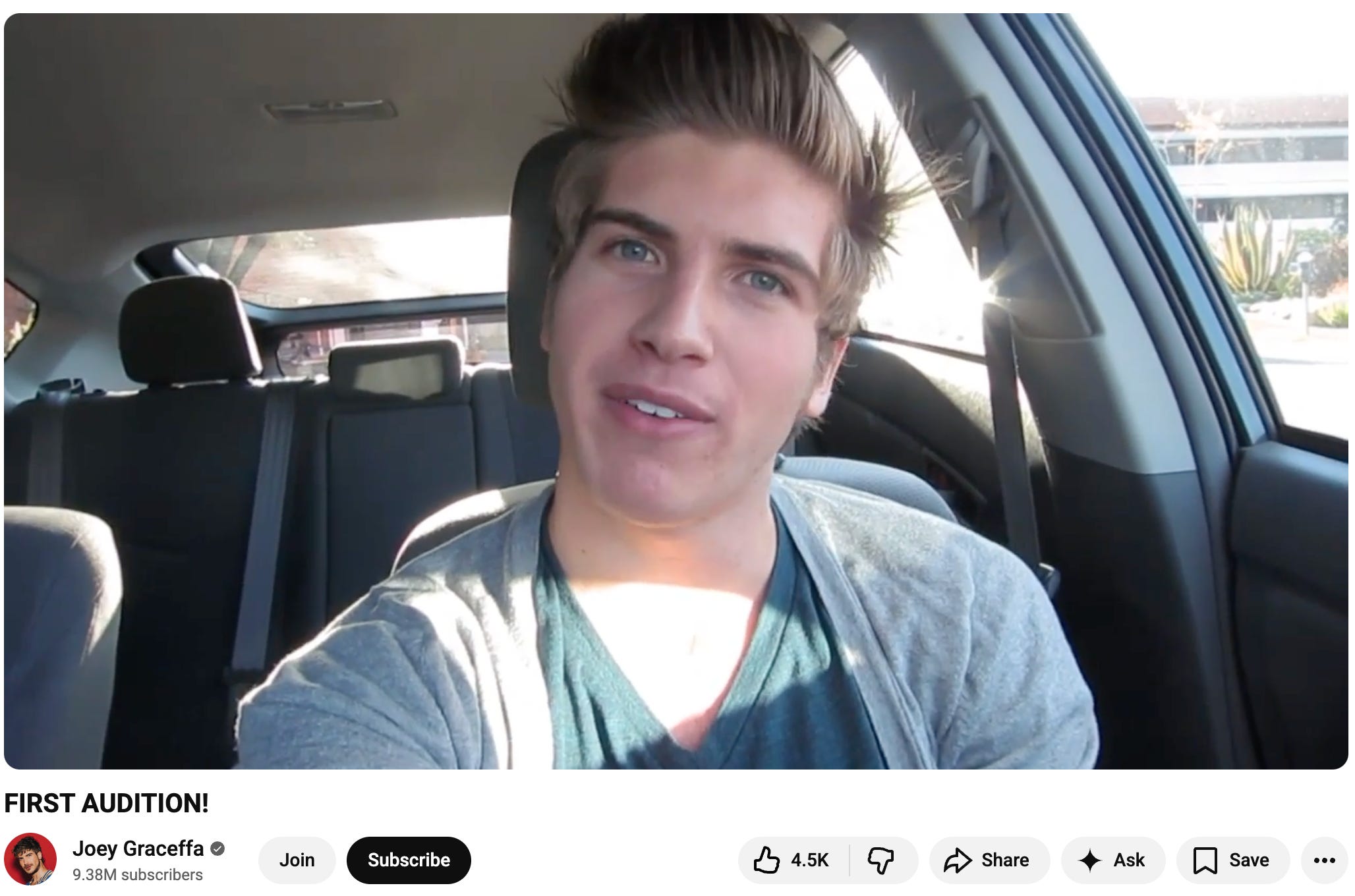
    Around 2012-2014, it became clear that if you wanted to become a YouTuber, you needed to move to LA since all the popular and well-known YouTubers lived in LA. Plus if you lived in LA, it made it easier to do collaborations with other YouTubers. I started to tune into Joey Graceffa’s channel a lot more around this time, where he’d not only upload Minecraft videos onto his gaming channel, but also vlog on his main channel about his daily adventures living in LA as a YouTuber. He shared an apartment with Sawyer Hartman, another YouTuber, as Joey would upload “ROOMMATE TAG!” onto this main channel.

    Watching my favorite YouTubers live in sunny Los Angeles from the East Coast, I started to feel this rush of excitement, primarily because I had never visited the West Coast before. But with the emotions of excitement came along huge waves of FOMO (fear of missing out) as it felt like everything cool and new was happening across the country. All YouTube related events were in California, like VidCon and other YouTuber meetups with their subscribers were locally planned in LA. It was around this time too that I was introduced to Coachella, the music festival, since other popular YouTubers vlogged their experience or would upload related videos like reviewing Coachella outfits and must-haves. I even remember one of my middle school friends talked about how we would beg our moms to buy us tickets to Coachella to partake in the fun and plan out our trip. Of course this idea was out of the picture and scrapped due to our finances and living situation.

    YouTuber pipeland to Hollywood

    I felt like I was missing out on all the fun happening in LA, since not only my favorite YouTubers were living there but also famous stars I liked where there as well. The universe of YouTubers and Hollywood became enmeshed as YouTubers like Joey Graceffa, Shane Dawson, and others, tried to nudge themselves into Hollywood.

    Screenshot by me

    As I became more invested watching YouTubers and their lives, a handful of them would open about their creative endeavors outside of YouTube, such as becoming actors, film & tv producers or directors of their own shows. While being full-time YouTubers, they’d hustle on the side actively building their professional portfolio to break into the media & entertainment industry. It comes as no surprise looking back now that YouTube became an active tool to create and open up opportunities. The ability to get ones name out into the public seemed more feasible thanks to YouTube as the chances of going viral was anyone’s game. YouTube made it possible to provide LA YouTubers the exposure they were looking for.

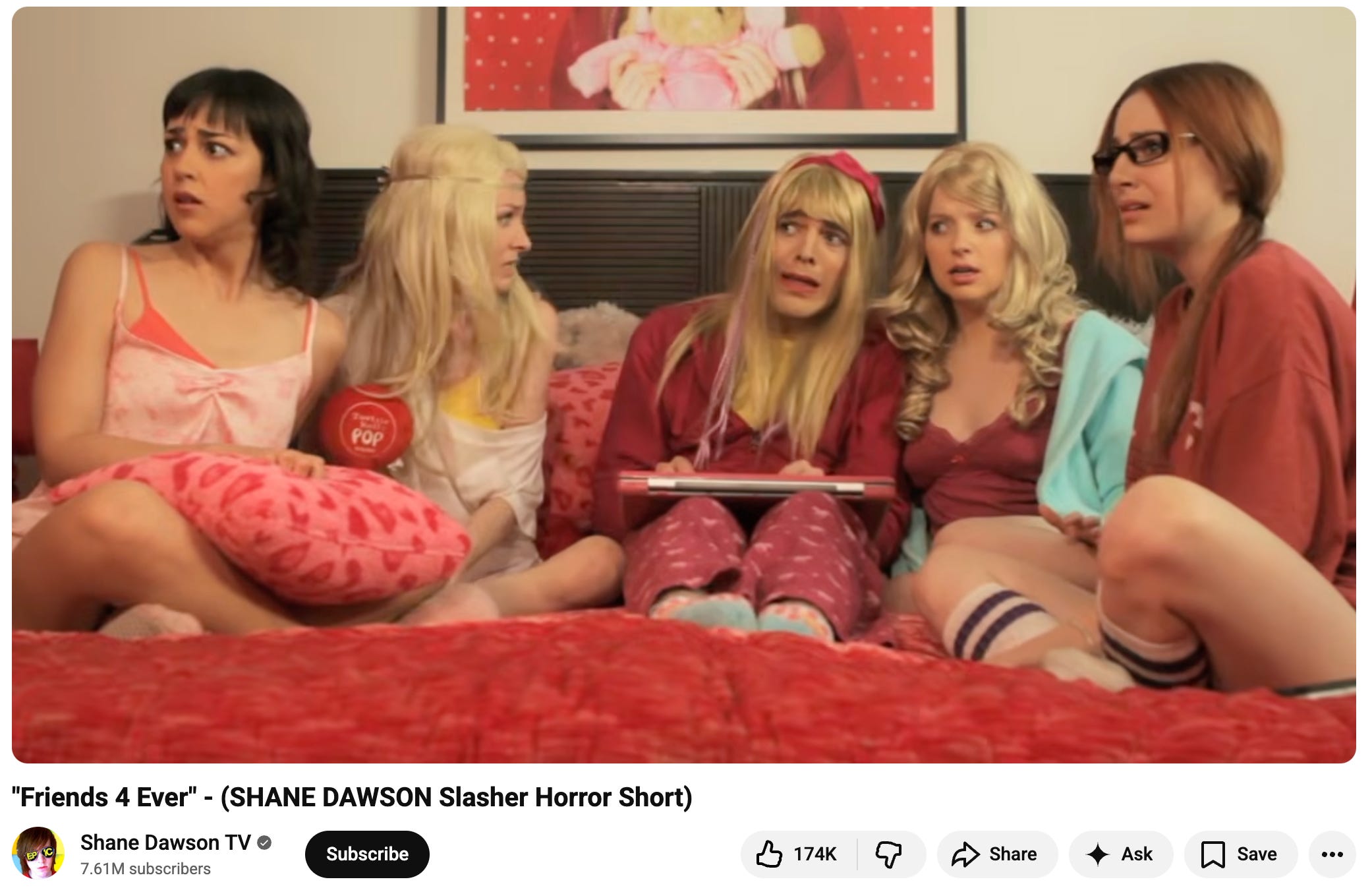
    As cringy and embarrassing it is to admit now, I used to watch Shane Dawson’s channel, and a majority of his early YouTube videos since he was fairly popular at the time and happened to know a lot of other YouTubers. Watching Shane’s channel was like watching a weird indie film– a lot of edgy jokes and a healthy amount of sarcasm (not to mention the lowkey racist undertones). From watching his channel I learned about his passion for making his own movies and dream of becoming a film director as he continuously experimented in every video he uploaded.

    Screenshot by me

    By the time I left middle school, the idea of creating my own YouTube channel and uploading videos still sat with me. I was inspired watching my favorite YouTubers create their own ideas into reality. Joey Graceffa created his show Storytellers on YouTube, and Shane Dawson made his horror film Smiley. A sense of motivation and ambition would wash over me whenever I witnessed YouTubers create great ideas from scratch into real-life results (and getting paid to do so).

    But something shifted on YouTube somewhere between 2015-2016, as YouTube was not the same YouTube as it was before when I first started watching, as ads were becoming more frequent & normalized on videos and the algorithm that was introduced somewhere in 2015 was hurting smaller channels who were just getting started. LA was now oversaturated with YouTubers or those wanting to become YouTubers. Media conglomerates like NBC, ABC, and FOX were now creating their ownYouTube channels, and even celebrities started to upload and create videos of their own. It felt weird, it felt like YouTube started to become Hollywood and more manufactured, and the more it became like this, I was less engrossed in it.

    I noticed that when I got to high-school, I became a little less invested in my favorite YouTubers and watching their daily vlogs, as creating friends and socializing took up most of my time. Though YouTube still served as my main source of entertainment and a source of comfort to me whenever I was free. Once I reached my senior year of high-school, 2019, my watch time on YouTube gradually decreased. I became preoccupied with preparing for college, friends, and entering a new chapter of my life, and oddly enough, it seemed like most of my favorite YouTubers were also entering different eras of their lives too. Many had go on to publish their own books, start up podcasts, pursue other business adventures–some even stopped uploading onto their channels altogether by 2019. We had all grown up as some even started families and were getting married and/or engaged. As we neared the end of 2010s, YouTube was completely different.

  • COVID-19 & Content Creation

    how covid impacted content creation


    GummyBone via iStock

    It would be an understatement to say that COVID-19 changed the world. Anyone and anything were impacted by the contagious virus, as entire economies–not just financial ones–and institutions were at the mercy of a global pandemic. Though I want to particularly touch on how lockdown impacted both the consumption and production of content creation. What I mean by this is that our relationship as both viewers and producers of content shifted as a result of being confined to our homes. Seemingly despite having more free and idle time during lockdown, short-form content like TikTok saw an upsurge in popularity. Moreover, as work from home became a new reality for those in the position and privilege to do so, content naturally became more confined to private and domesticity spaces.

    It is noteworthy that the shift between short form to long form content and vice versa has always existed on social media platforms prior to 2020. In fact, most popular platforms like Twitter (now Elon Musk’s’ X) and Instagram began with only having short form content before expanding to long form content. In the early days of Twitter, Jack Doherty’s Twitter, posts were no longer than 140 characters, resulting in language and ideas to be circumscribed. This nettlesome but unique feature set apart Twitter from other early social media platforms, forcing users to be creative and brief in their posts. The decision for 140 characters was not based on Doherty’s preference but due to the capacity the platform could handle at the time. It was not until November 2017 when Twitter increased the character limit to 280, an additional 140 characters. There were mixed feelings coming from users, some were happy that they no longer needed to confine themselves to 140 characters or less, whilst others felt that the character limit is what gave Twitter its identity and popularity.

    Instagram experienced a similar gradual shift from short form to long form content. In 2010 when Instagram launched, users were only allowed to post one photo per post. One single photo per post sounds unbelievable compared to where Instagram is now, but just like Twitter, the social media platform’s bandwidth was still in its preliminary stages. Eventually in 2013, 15-second videos were introduced onto the platform. Users were no longer bounded to still-images to create storytelling and sharing of ideas, as moving images made posts more engaging and fun. Though just like Twitter in 2017, Instagram inched towards long-form content by announcing their ‘carousel feature’, which allowed users to post up to 10 photos or videos in a single swipeable post.

    As content became more elaborate on social media, innately short form content progressed into long form content. Of course, depending on the type of content and genre, the choice for short form or long form content could sway either direction. Think of 2013 when Vine came out, most of the popular and recognizable Vines were comical and blithesome. It made sense that comedy was compatible as a short-form content, as users got creative on how to make 6 seconds worthwhile for a quick laugh. Despite Vine’s short-lived legacy, Vine should be considered as a case of ‘ahead of its time’, as now in 2026, short-form content seems to be what users have an appetite for with TikTok, Instagram reels, and YouTube shorts. Perhaps Vine gave social media users a sneak peek for how effective but still entertaining short-form content can be as it saw a reemergence in 2020.

    Notably, 2020 was a traumatic and eerie year in the United States. Statewide lockdowns were in place, COVID cases were rising every day, and the news became all too morbid to bare. For non-essential workers stuck at home, figuring out how to pass the time was a common experience. Still, with all the time in the world, people were consuming far more short-form content during the pandemic as TikTok was named the most downloaded app in 2020.

    But why?

    Well, there was an already overwhelming sense of traditional media fatigue and agitation that the pandemic unveiled and even exacerbated. Those who distrusted major television networks prior to the pandemic, found even more of a reason to not tune into news networks as misinformation regarding COVID circulated thanks to the unreliable Trump administration at the time. People intrinsically went onto social media to escape what was happening right outside their doors. Thus, short-form content acted as a substitute for our appetite in terms of media. TikToks were fast and effective in communicating and sharing of ideas, creating a sense of dopamine for an entire dormant audience.

    Shifting gears over to the production of content during lockdown, it is useful to view this relationship in parallel to how prevalent work from home became. As many jobs had to adopt to work from home (primarily office jobs), so did content creation. Content became more insular as socializing with others and going outside was interfered by lockdown. Naturally with home now being the main site of everyday interaction during quarantine, users on social media were more susceptible to being vulnerable and exposed. The presentation of the self as content heightened as the line between public and private spaces blurred as content entered domesticity. Echoes of this still function as a form of content-making in 2026 as the lack of boundaries between the private and public space was obstructed by COVID.


    Sources:

    Instagram. “Introducing Video on Instagram.”

    Anonymous. “TikTok named as the most downloaded app of 2020.” BBC.

    Amelia. “Twitter’s Evolution: From 140 Characters to Now.” Medium.

    Constine, Josh. “Instagram lets you post up to 10 photos or videos as 1 swipeable carousel.” TechCrunch.

  • Content Creator or Influencer?

    why we should start using the term content creator more in 2026


    Nubelson Fernandes via Unsplash

    “A content creator is different from an influencer–they are two separate things,” former YouTuber Catrific, also known as Cat Valdes in real life, expressed to me over the phone. I spoke with Cat back in April about her experience being an early YouTuber, creating content, and what happened after ‘retiring’ from YouTube. Being a former content creator herself, her distinction between the two terms was significant to me, as over the past year in my research I have observed these two terms often being used synonymously with one another through discourse on social media. This is problematic to me, let me explain why.

    Not everyone on social media that creates content and has a large following is an influencer. There needs to be clarity amongst these two terms in order to understand and allow dialogue regarding evolving online presences on social media. Thus, when one generalizes all online social media presences to just an influencer, dialogue is limited and rigid.

    To the naked eye content creators and influencers may seem identical, as content creators and influencers share similar practices, like monetization from content and the self, and primarily existing on social media platforms. However, I suggest that these two terms are entirely separate online entities. From my observation having both online and offline conversations regarding this very topic, the term influencer is being treated as a catch-all phrase, in an attempt to label and categorize a wide array of social media identities.

    One plausible cause for this might be the outdated language and prior discourse on online identities and self-presentation on social media. Books such as Brooke Erin Duffy’s (Not) Getting Paid to Do what You Love (2017) and Sarah Banet-Weiser’s Authentic ™: The Politics of Ambivalence in a Brand Culture (2012) provide a good baseline for understanding early online social media presences yet generalizes them. Moreover, the term content creator was not commonly used as it is now in 2026. Publications revolving online social media identities need to catch-up to language being used today on social media.

    So, what is an influencer?

    Influencers on social media today are public-facing online personas with a massive following, most commonly seen on Instagram. They partner up with companies and brands for sponsorships, often becoming an ambassador for a certain product that a company wants to sell. Influencers are used as another source for marketability and audience engagement and reach. In other words, influencers can be understood as individuals that both monetize and mobilize capitalistic ventures and avenues. Most popular influencers tend to be white cis women as well. Moreover, to be an influencer you need to be well-known, as one key component about a being influencer is being deemed recognizable enough to an audience by companies and sponsors to be marketable.

    On the other hand, to be a content creator you do not need to be recognizable or even have a large number of followers. Content creators are individuals who produce a wide variety of online engagement to an online audience, via any social media platform like YouTube, Instagram, Twitch, TikTok, etc. It could be creating original content like short films, live streaming, uploading commentary videos, ASMR, etc. Content creators also often monetize this engagement as a source of income, though not always. They are more evolved, refined, and flexible compared to influencers, who are tied down to one single format of which is to be a marketable persona. Additionally, content creators do not necessarily need fame and recognition to be successful, as becoming rich and famous is not the sole purpose for creating content online. Very rarely, if one is lucky enough, fame and recognition is a byproduct from their content. Early content creators can be thought of as YouTubers like Jenna Marbles, PewDiePie, and Ryan Higa. The term content creator is both used as a practice but also a noun, when people identify themselves as a content creator.

    The term content creator seems to be a recent phenomenon, however, content creators have always existed as I argue that YouTubers, like Catrific, were one of the first content creators in the age of social media. I like to visualize content creators existing within Richard Florida’s–American urban studies theorist and author–theory of the creative class. In his book The Rise of the Creative Class, Florida identities the creative class main characteristic and function as individuals who are innovators and trailblazers, creating meaningful new forms and expression.

    In a 2024 global survey from Florida’s Creative Class Group, he defines ‘creators’ as individuals with over 1,000 followers on their primary social media platform who create and share original content. My issue with Florida’s definition is that it’s too rigid and insufficient. For instance, 1,000 followers is a specific metric that does not necessarily translate to whether or not someone can be deemed a content creator or not, especially if someone tends to have a huge following without creating content online.

    Even as I write this, the phenomenon of content creators and content creation is evolving as social media changes, and new language emerges to describe new online entities. I shall end with this–content creators as a subject itself needs to be taken into consideration and taken seriously when it comes media studies, which is what I hope to achieve.


    Sources:

    Banet-Weiser, Sarah. Authentic ™: The Politics of Ambivalence in a Brand Culture. 2012

    Duffy, Brooke Erin. (Not) Getting Paid to Do what You Love: Gender, Social Media, and Aspirational Work. 2017

    Florida, Richard. The Rise of the Creative Class. 2012

    Florida, Richard. The Creator Revolution: Results from a Global Survey Creative Class Group.

  • A Tale of Two Cities on my YouTube Page

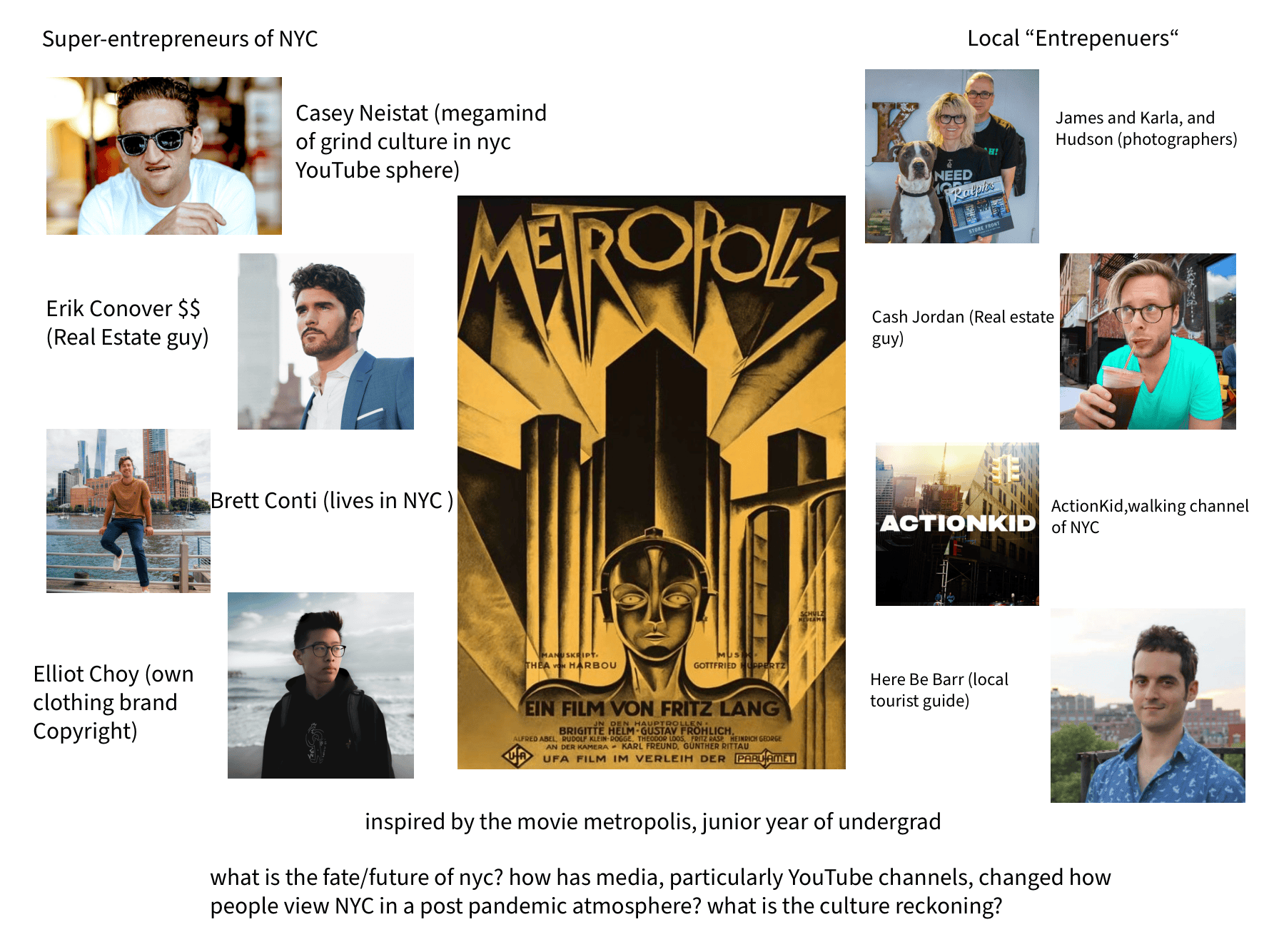
    Only being a year out since lockdown, I still felt as though I was not able to fully venture and explore my city, so watching NYC related content felt like a “check-in” to see how other parts of the city was handling and navigating the changing environment post-lockdown. Aside from watching James & Karla and ActionKid, I started to watch more YouTube channels from NYC content creators like Cash Jordan and HereBeBarr during 2021.

    I learned about Cash Jordan through YouTube’s algorithm as it saw that as I started to consume more NYC content, thus more NYC related channels started to appear on my homepage.

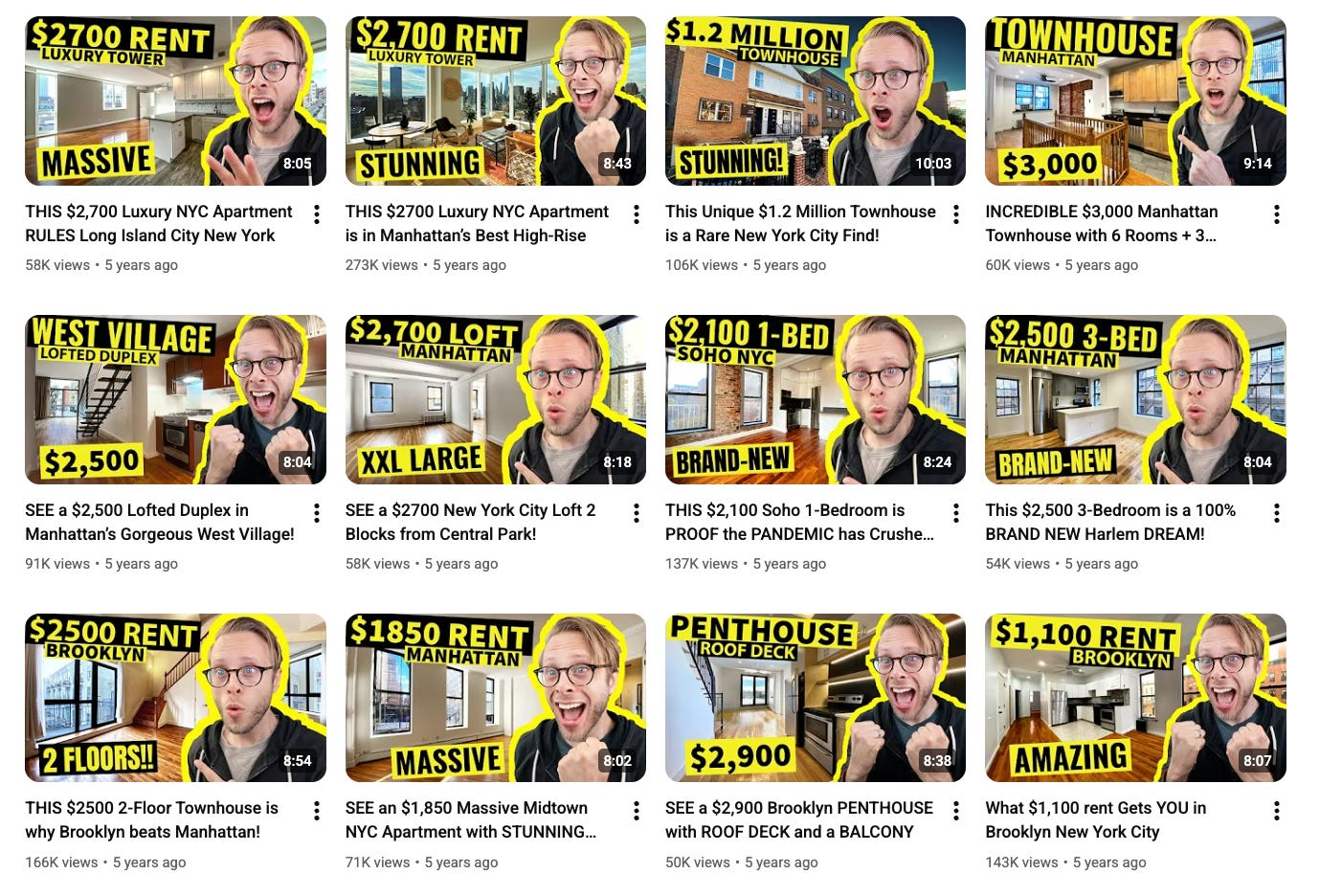
    Cash Jordan’s channel from 2020 – 2023 follows him as a real estate agent, showing off apartments in the city, some affordable and some luxurious condos and penthouses located in midtown or downtown Manhattan. Cash was not only uploading videos onto his YouTube channel as he also would upload these apartment tours on TikTok. In some early videos where he’s vlogging out on the street, strangers would often come up to him and say “Hey you’re the TikTok guy, right?”

    As previously mentioned in my first post, New York City’s real estate market was facing a crisis as many people fled the city during lockdown, since NYC became an early epicenter for the virus. Therefore with many apartments now emptied and vacant, and heavy COVID restrictions implemented, no one was in a rush to move back to the city. Cash Jordan mentioned this time and time again in his videos, as he would walk around the city and talk about the state of the real estate industry, especially since he too was feeling the brunt of this financial loss. Though he would continue to advertise these apartments and hope that when COVID restrictions would lift, people would be enticed to get in contact with him for these rental listings.

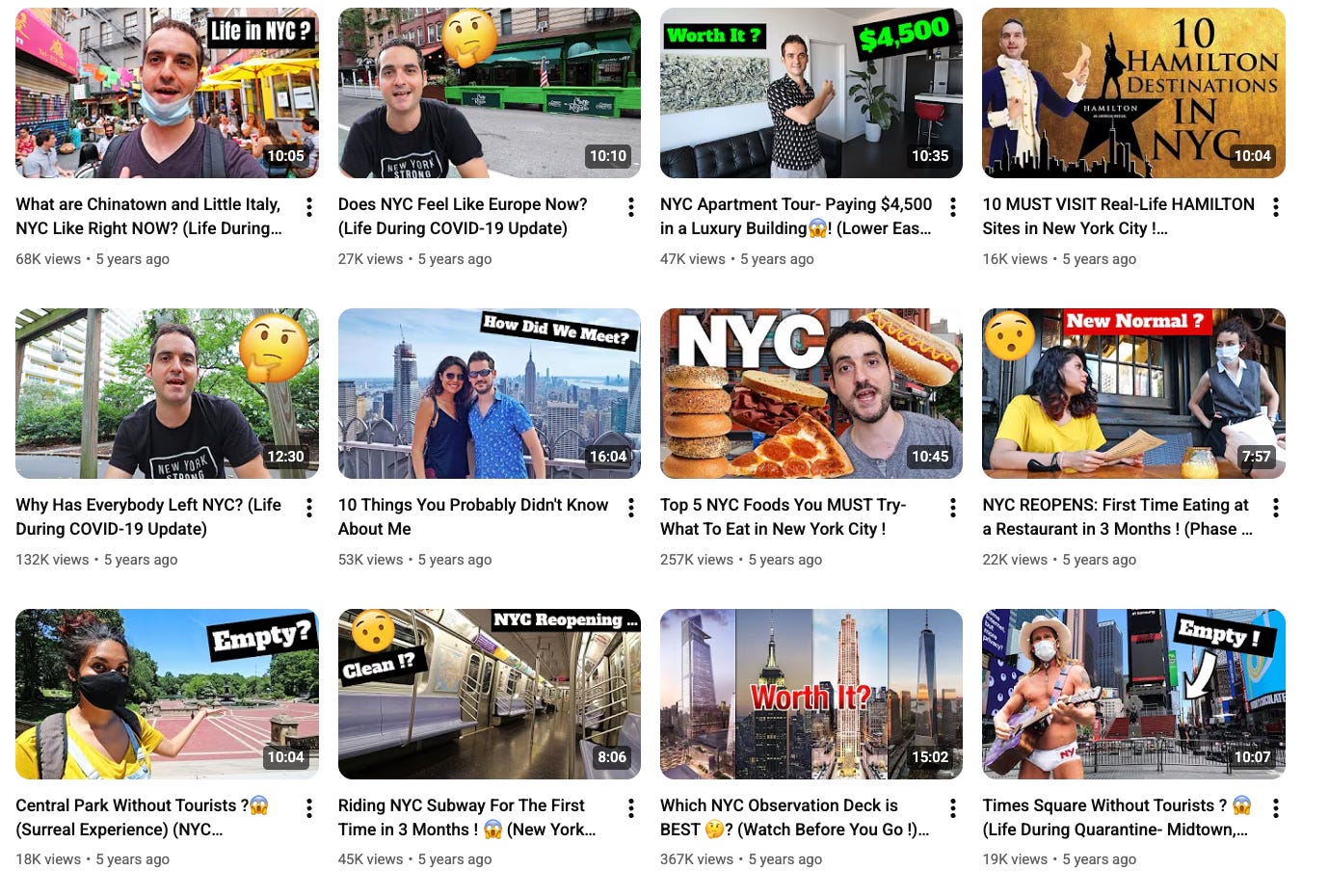
    The real estate industry was not the only business in NYC facing serve financial loss, as tourism was at a complete halt. In one video of Cash Jordans’ Here Be Barr was featured as they walked around the city and chatted about where the state of the city was in, and speculated the future of New York City. I remember this was a popular conversation even amongst my friends and I, as we wondered if our beloved city would return to normal, and if it would ever be the same as before.

    Here Be Barr’s channel was centered on tourism in NYC like the best local spots to go to, which unexplored areas tourists should visit in the city, and so forth. But when COVID-19 took a turn, his channel pivoted to updating his viewers on the state of NYC and whether it was worth coming to visit, or to hold off until more COVID restrictions were lifted from the city.

    I noticed amongst all these YouTube channels, James & Karla, Action Kid, Cash Jordan and Here Be Barr, all were documenting the changing business landscape of NYC. James & Karla with highlighting mom and pop shows along with Action Kid, Cash Jordan with the real estate industry, and Here Be Barr with the entertainment industry.

    All of these content creators stayed in the city during lockdown, as they showed the reality and gravity of the situation of NYC during one of its toughest times. I knew the gravity of the situation in my city was troublesome as I, like so many during this time, became glued to my local news. I would watch the news religiously as more new stories circulated about another business shutting down, a rise in COVID cases, or residents struggling with affording groceries since so many had lost their jobs due to COVID.

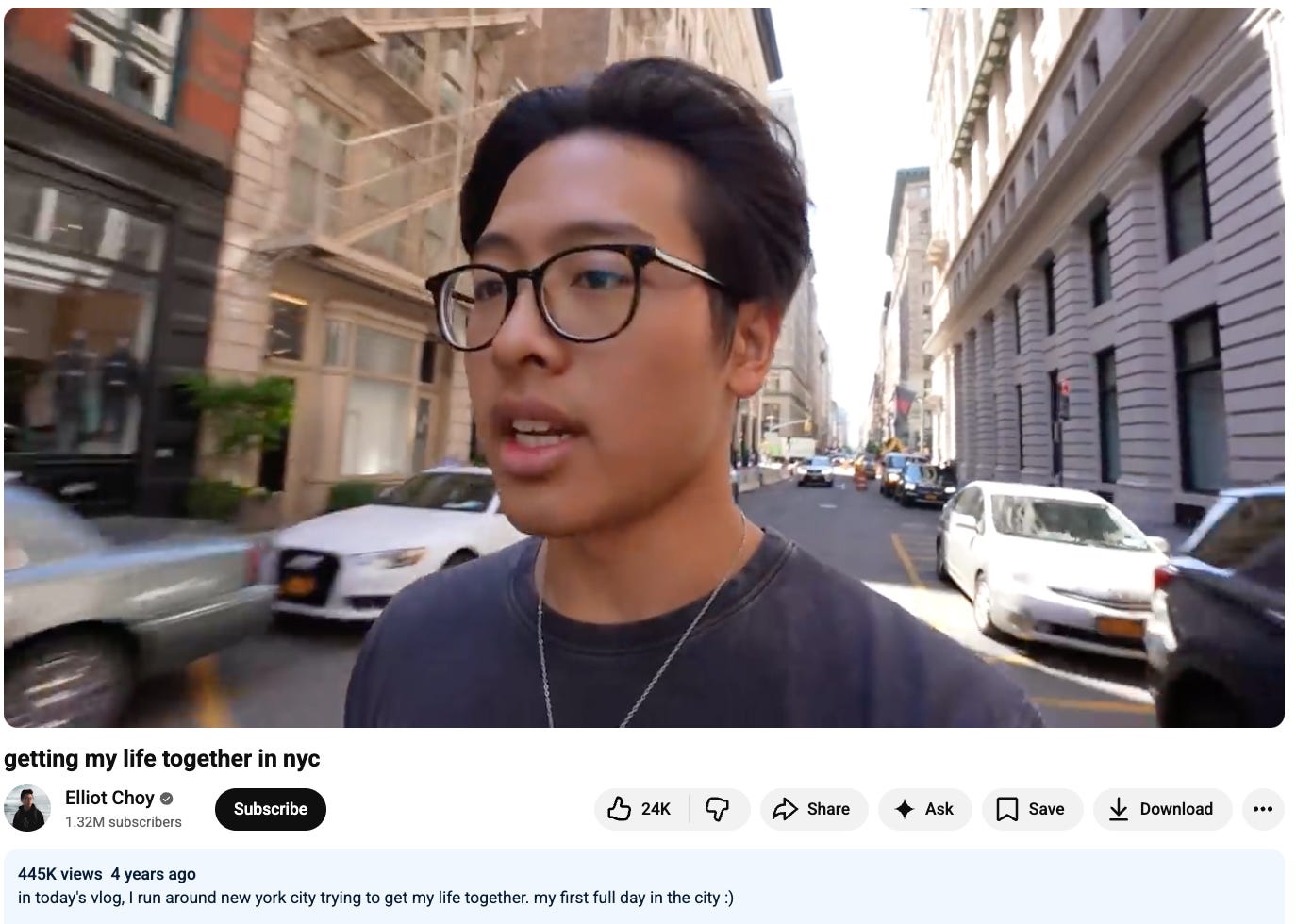
    All of it felt exhausting and overwhelming, until it didn’t, when I started to watch these new NYC content creators like Elliot Choy and his content creator house. When I wanted to escape the harsh reality of the state of NYC, I would watch Elliot Choy’s videos as he began his new era living in the Big Apple. I felt inspired by this newly graduate as he was full of ambition in a city where people were beginning to lose hope. In almost of his videos, he would speak on his journey as as young content creator and starting up his business and the routine of self-discipline and journaling. Following Choy throughout NYC felt different, it felt releasing. The upbeat music included in his videos definitely added to this effect.

    I remember being so inspired by one of Elliot Choy’s videos that I researched how much was a booster board so that I could travel throughout the city without having to take the subway. Much to my disappointment, booster boards were really expensive and this small itch of mine quickly died down after looking at the price online.

    My relationship felt weird to NYC during this time to say the least. I was overjoyed with inspiration and drive from Elliot Choy’s videos, yet on the other hand, I was concerned and worried with the reality of my city’s financial state as James & Karla and other local NYC content creators were documenting the challenges we were still facing as a city. I was expected to graduate in about a year and look for employment. The idea of looking for employment felt taxing and like a crude joke when the graduating class of 2020 was still struggling to find a job nearly 2 years into the pandemic.

    This conflicted feeling led to frustration. I felt lied to and disillusioned. I eventually saw two sides of my city on my YouTube homepage, the ‘real’ NYC versus the romanticized version of NYC. This vulnerability really shined through during the pandemic as those who had the money to ‘escape’ a global pandemic and not be too affected by the financial crisis going on felt like the best option. Whilst there were those who could no longer afford rent due to losing a job, etc.

    At the time, to me it felt like there were two types of content creators in NYC. Those who were taking advantage of the situation, low rents, financial flexibility and availability to still live normally in the city while creating content versus those who were more humble in their efforts in creating content in the city. This polarization and viewing of content creation in a city stumped me in my research.

    By 2023, I tried to make sense of seeing these two sides of NYC by creating two categories: super entrepreneurs versus local entrepreneurs.

    I first presented this idea to my graduate core class, as premature and defensible this chart is, this early terminology was the first step in trying to figure out what I was really trying to get at with this classification between these two types of content creators in NYC.

    Even though I reference Charles Dickens here, there are so many more references that come to mind when thinking of New York City and the dichotomy of its two environments: the real NYC experience versus the romanticized experience of NYC.

    Here is what I defined the two as:

    real NYC = community & investment

    romanticized NYC = consuming & divestment

    Stopping here for just a second–to view any city in this binary, not just NYC, is fundamentally problematic as it does not allow room for conversation to viewing and experiencing a city another way. It closes up dialogue and is uninviting.

    I eventually came to this realization much later from where I first started with this research project, as it came so easy and instinctive for me to view NYC as blatantly classist being the child of a former maid/nanny (primarily in its power structure of work & labor). And despite identifying this flawed binary perspective, I still believe and view NYC as a classist city.

    Let me be clear: two things can be true whilst still being at odds with one another.

    NYC is a place for born and bred New Yorkers like myself, who live and work in the city, who grind and hustle, who experience the everyday nuances of living in a city like NYC. While on the other hand, NYC is also a place for outsiders to have fun, indulge in luxury, and consume endlessly til their hearts desire. This statement can be problematic for many, as it may come off as if I am complacent with my city being a playground for transplants and die-hard consumerists–I’m not.

    Simply put: when you have moneyyour experience of NYC is different as opposed to when you don’t have money. The way you consume NYC is different.

    Admitting this bitter truth about my city is a hard pill to swallow, but it’s the reality for most cities. Including classism as a concept to my research is necessary, or at least I view it so, to better understand a deeper understanding of how content creators have added to our cities as part of the creative class, and how this impacts or disrupts an already existing labor structure in a city.

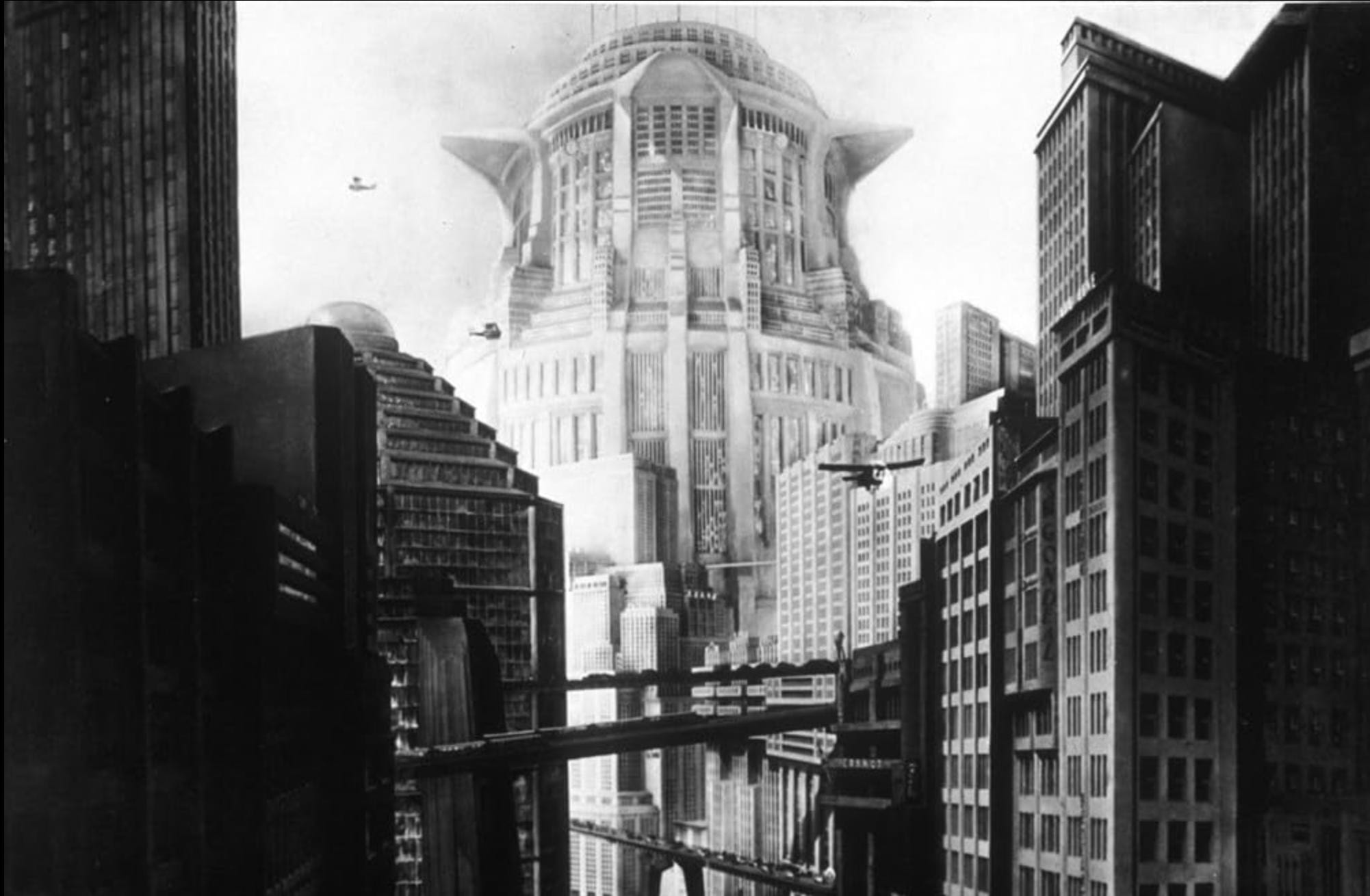
    The photo being referenced in the chart above is from Fritz Lang’s 1927 film, Metropolis.

    I first watched this film in my junior year of college in my Robots & Film class. Despite the film being silent, it spoke volumes (pun intended) on every day modern problems that metropolitan cities like NYC see everyday. The poor working class, working everyday to the bone, while the upper wealthier class sits at their throne, watching over a city get constructed and operated by faceless workers. Metropolis hit home for me due to the structure of the city and its labor.

    I attached realities of the high and low class to the NYC content creators I was watching, and as much as I trying to attach certain characteristics to one or the either, neither made sense to me. So I ended up dropping this polarizing idea altogether.

    I view all NYC content creators as part of an ecosystem that is the creative class (Richard Florida). What I found more interesting from all these content creators was the migration of some like Elliot Choy moving to NYC during a time of financial crisis and cultural crisis as well. It was around 2023 that I began to see more NYC content creation on YouTube and Instagram, and even some conversations on Twitter.

    Was NYC becoming the spot to become a content creator in a post-COVID world?

    More ‘influencer’ centered stores were tailoring to content creators in the city and the work from home model that came out of COVID made it easier for people to just begin creating content, especially with the “day in my life” in NYC. I saw all of this as a new form of business that sprung out of COVID, or maybe COVID acted as a catalyst for this?

    But I knew that we had seen this migration before in content creation. We saw it first with YouTubers and LA.